
Everything You Need to Know Upfront
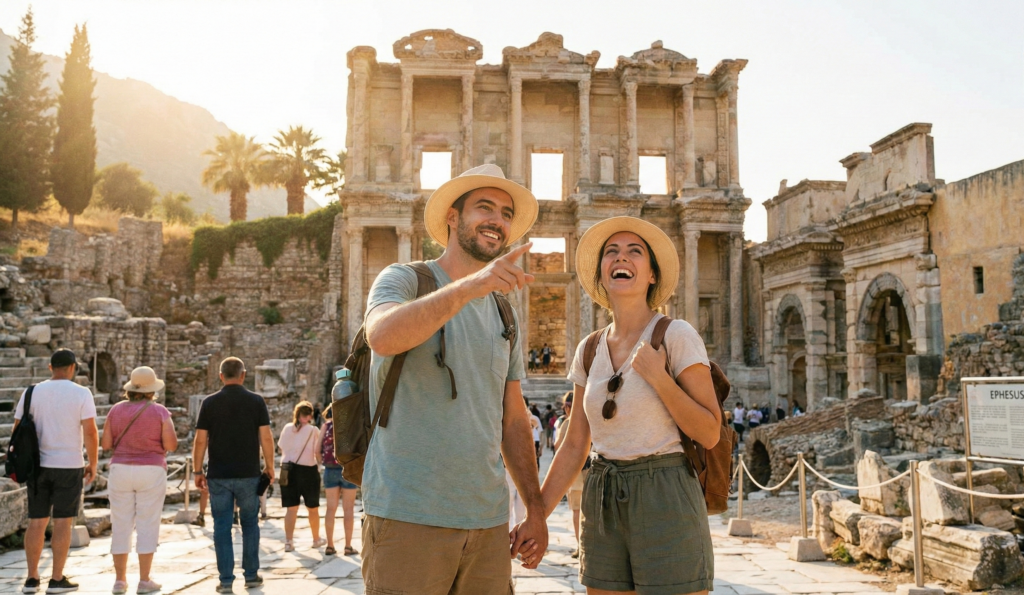
You are planning a trip to one of the most significant ancient cities in the world. You want to know the best way to spend a day in Ephesus. The answer is simple. Start your tour at the Upper Gate (Magnesia Gate). Walk downhill towards the Lower Gate. This route saves your energy. It allows you to see the city unfold in chronological order.
Arriving early is crucial. The gates open at 8:00 AM. Being there right when it opens helps you avoid the heat. It also helps you stay ahead of the massive cruise ship crowds. You will need comfortable shoes for walking on marble streets. You should bring water and sun protection.
Ephesus is not just a collection of ruins. It is a journey through history. It was a bustling metropolis of the Roman Empire. Walking its streets feels like stepping back in time. This guide covers every detail you need for a perfect visit. We will explore the Library of Celsus, the Great Theatre, and the Terrace Houses.
Let’s dive into the details of your unforgettable journey.
Preparing for Your Journey: Logistics and Timing
Success lies in the details. A well-planned day in Ephesus begins before you even arrive. The site is located near the modern town of Selçuk. It is easily accessible from Kusadasi and Izmir. However, transportation choices matter.
Private tours offer the most flexibility. They allow you to move at your own pace. You can linger at the sites that interest you most. You do not have to wait for a large group. This is the best way to maximize your time.
Tickets can be purchased at the entrance. However, buying them online in advance is smarter. It saves you from waiting in long lines under the sun. The “Museum Pass Türkiye” is a great option if you plan to visit other sites.
The weather in this region can be intense. Summers are hot and dry. Winters are mild but can be rainy. The best months to visit are April, May, October, and November. During these times, the temperature is perfect for walking.
You should plan to spend at least three to four hours inside the ancient city. This duration covers the main highlights. If you add the Terrace Houses, add another hour. Do not rush. Every stone here has a story to tell.
Entering the Ancient World: The Upper City
Your walk begins at the Magnesia Gate. This was the ceremonial entrance to the city. As you step inside, the modern world fades away. You are now in the administrative heart of ancient Ephesus.
The first major structure you see is the State Agora. This was a vast open square. It served as the political center of the city. Discussions about laws and state affairs happened here. It is less crowded than the lower parts of the city.
Next to the Agora stands the Odeon. It looks like a small theater. It was actually a council chamber and a concert hall. It had a roof in ancient times. This structure held about 1,400 people. The acoustics are still impressive today.
Across from the Odeon is the Prytaneion. This was the town hall. The sacred flame of Ephesus burned here day and night. It was a symbol of the city’s eternal life. Priests guarded this flame with their lives.
Walking further, you reach the Domitian Square. It is named after the Emperor Domitian. You can see the remains of a massive temple here. It was the first temple in Ephesus dedicated to a Roman Emperor. This area sets the stage for the grandeur to come.
The Heart of Ephesus: Curetes Street
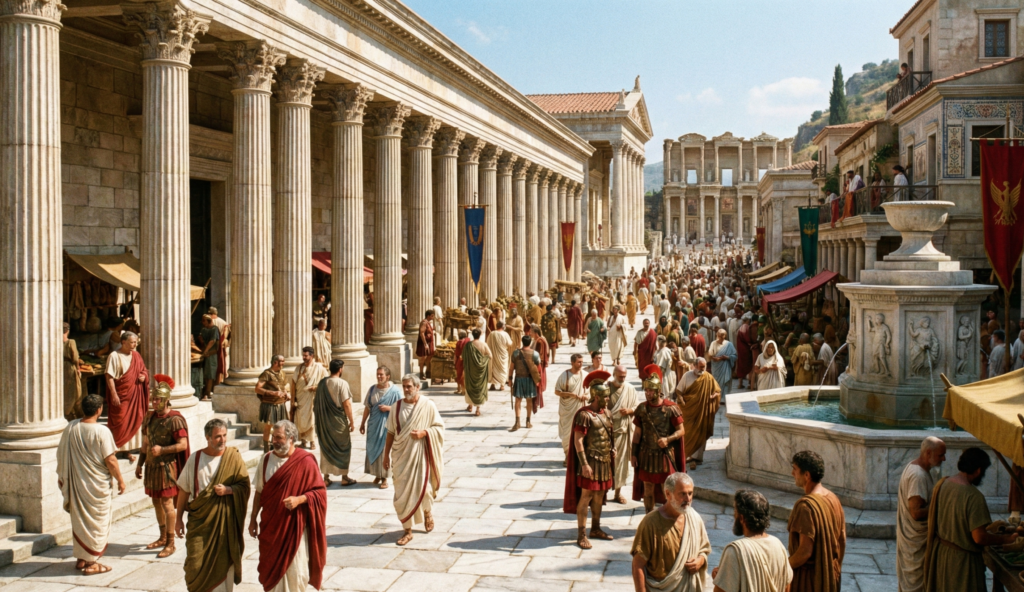
As you leave the political atmosphere of the Upper Agora, the city changes. You are now stepping onto Curetes Street. This was the main artery of Ephesus. It connects the administrative upper city to the cultural lower city.
The street is paved with smooth marble. In ancient times, it was lined with statues of important citizens, doctors, and politicians. Behind the columns, there were luxury shops selling silks, perfumes, and spices. Walking here feels like strolling down the “5th Avenue” of the ancient world.
The slope is gentle, but the history here is dense. Every few steps reveal another masterpiece. However, one building stands out above the rest: The Temple of Hadrian.
The Temple of Hadrian: More Than Meets the Eye
Located about halfway down the street, this temple is a jewel of Roman architecture and a key highlight of the UNESCO World Heritage site of Ephesus. It was built in the 2nd century AD to honor Emperor Hadrian. The facade is elegant, featuring four Corinthian columns and a curved arch.
Most visitors take a quick photo and move on. They miss the fascinating details hidden in the stone carvings. To truly understand this structure, you must look closer at the reliefs above the door.
The Mystery of the Stone Guardian: Medusa
If you look at the center of the inner arch, you will see a familiar face. It is Medusa, the mythological monster with snakes for hair. In Greek mythology, her gaze turned living people into stone.
You might wonder: Why is a monster carved on a temple dedicated to a beloved Emperor? The answer lies in ancient superstition. This is a concept called “apotropaic magic.”
The Ephesians believed that evil spirits and bad luck were afraid of monsters. By placing a terrifying image like Medusa on the entrance, they were protecting the temple. She was not there to scare the worshippers. She was there to scare away evil. It was a spiritual security system that has lasted for 2,000 years.
The Legend of the Wild Boar and the Fish
On the friezes (decorative bands) of the temple, another story unfolds. These carvings tell the legendary foundation of Ephesus.
According to the myth, a prince named Androclus wanted to found a new Greek city. He asked the Oracle of Delphi for guidance. The Oracle gave him a cryptic riddle: “A fish, a wild boar, and fire will show you the way.”
Androclus was confused but sailed to this coast. One day, while he was cooking fish for dinner, a live fish jumped out of the pan. It scattered the hot coals into the dry bushes. The bushes caught fire.
Suddenly, a wild boar hiding in the bushes ran out to escape the flames. Androclus chased the boar and killed it. At that moment, he remembered the prophecy: The fish, the fire, and the boar had met. He built Ephesus on that exact spot. These carvings preserve that founding legend in stone.
The Fountain of Trajan
Just before the Temple of Hadrian, you will see the Fountain of Trajan. In its glory days, this was a massive two-story structure. It featured a colossal statue of Emperor Trajan standing in the center.
The water flowed beneath the statue’s feet into a large pool. It symbolized the Emperor’s power over nature and his generosity to the people. Today, only the feet of the statue remain, but the scale of the fountain is still impressive. It reminds us that water was a luxury in the ancient world, and Ephesus had plenty of it.
The Scholastica Baths and Public Latrines
Right across from the Temple of Hadrian, you find the Scholastica Baths. This was a massive three-story complex. It was not just a place to wash; it was a social club. Rich and poor alike came here to relax, get a massage, and gossip about city politics.
Next to the baths is one of the most popular stops for modern tourists: The Public Latrines.
These ancient toilets are surprisingly well-preserved. You can see the marble seats arranged side by side in a U-shape. Beneath the seats, a channel of fresh water constantly flowed to carry away waste.
There were no dividers between the seats. Privacy was not a priority for the Romans. Using the latrine was a social activity. People would sit here, chat with their neighbors, and discuss business deals. It is a humorous and humanizing reminder that despite their grand temples, the Romans had very human needs.
The Crown Jewel: The Library of Celsus
At the end of Curetes Street, the view opens up. You are standing before the Library of Celsus. This is the icon of Ephesus. It is one of the most photographed ancient buildings in the world.
The library was built in the 2nd century AD. It was a monument to knowledge and power. It housed over 12,000 scrolls. The facade is a masterpiece of Roman architecture. It was designed to look larger than it actually is.
Take a moment to admire the statues on the facade. They represent Wisdom, Knowledge, Intelligence, and Valor. The originals are in a museum in Vienna. However, the copies here capture the spirit perfectly.
The library was also a mausoleum. The sarcophagus of Celsus is buried underneath the building. It is rare to be buried within the city walls. This shows how important Celsus was to Ephesus.
The best light for photos is in the morning. The sun hits the facade directly. It brings out the golden color of the marble. This is why starting early is so important. You get this view before the afternoon shadows fall.
A Glimpse into Private Life: The Terrace Houses
Right opposite the Library of Celsus lies a hidden gem. The Terrace Houses are often called the “Houses of the Rich.” You need a separate ticket to enter this section. It is absolutely worth the extra cost.
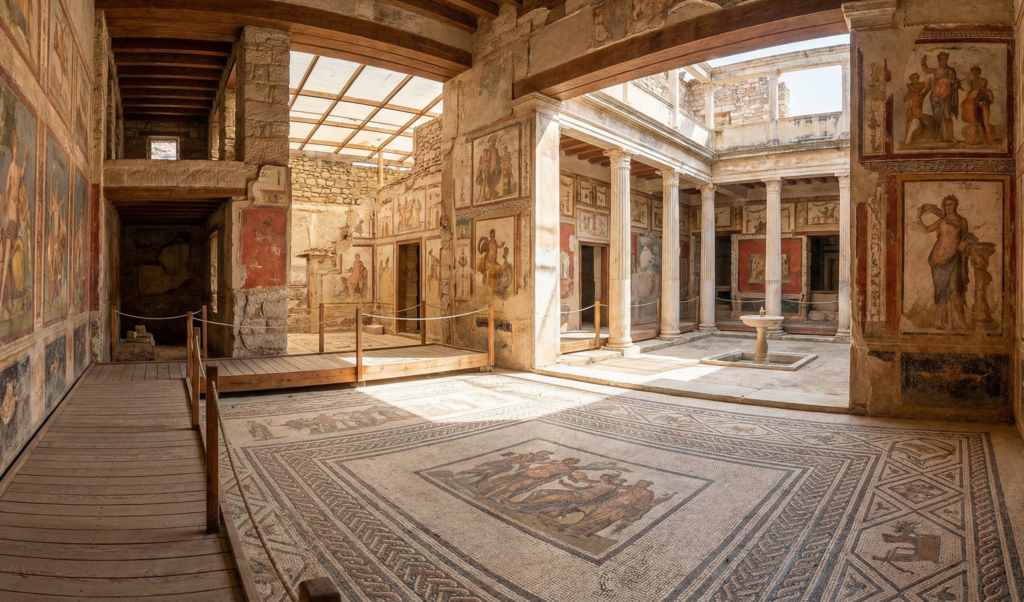
This area is covered by a modern protective roof. Inside, you walk on glass walkways above the ruins. You look down into the actual living rooms of the Roman elite. It is an intimate experience.
The preservation here is astounding. You can see intricate mosaic floors. The frescoes on the walls are still colorful. They depict scenes from mythology and daily life. It feels like the owners just left.
These houses had modern comforts. They had running water and private baths. They even had a floor heating system. This was the height of luxury in the ancient world.
Visiting the Terrace Houses gives you context. The big temples show the public life. These houses show the private life. It completes the picture of Ephesus. Do not skip this part of the tour.
The Grand Finale: The Great Theatre and Harbour Street
After leaving the intimate atmosphere of the Terrace Houses, you face something massive. The Great Theatre of Ephesus is carved into the side of a hill. It dominates the landscape.
This theater could seat 25,000 people. It is the largest in Anatolia. It was used for plays and concerts. It was also used for political and religious assemblies.
This is where St. Paul preached. His words caused a riot among the silversmiths. They feared his teachings would hurt their business. Standing on the stage, you can almost hear the echoes of history.
From the theater, you look down Arcadian Street. This is also known as Harbour Street. It was a grand avenue leading to the port. Sailors and merchants entered the city through this road.
The street was lined with colonnades and shops. It was lit by torches at night. Imagine the sight of ships arriving from Rome and Alexandria. Although the sea has receded, the grandeur remains.
Conclusion: Why a Private Tour Makes the Difference
A day in Ephesus is a memory for a lifetime. The scale of the city is overwhelming. The history is deep and complex. Navigating it alone can be tiring and confusing.
This is where we come in. Guided Ephesus Tours offers you more than just a ride. We offer you a narrative. Our professional guides bring the stones to life. We manage the logistics so you can focus on the experience.
We know the best spots for photos. We know the quiet corners away from the crowds. We tailor the pace to your needs. Whether you are a history buff or a casual traveler, we craft the perfect day for you.
Ephesus is waiting for you. Do not just see the ruins. Understand them. Feel them. Experience the magic of the ancient world with the comfort you deserve.
Ready to step back in history? Check our exclusive tour packages today. Let us plan your perfect day in Ephesus.
Frequently Asked Questions About Visiting Ephesus
How much time do I need to explore Ephesus?
You should plan for at least 3 to 4 hours. This duration allows you to walk from the Upper Gate to the Lower Gate without rushing. If you plan to visit the Terrace Houses (which we highly recommend), add another hour to your schedule.
Is there a specific dress code for Ephesus?
There is no strict dress code for the ancient city ruins. However, comfortable walking shoes are non-negotiable. You will be walking on slippery, uneven marble for hours. High heels or flip-flops are dangerous. If your tour includes the House of the Virgin Mary, please dress modestly out of respect.
Do I really need a private tour guide?
Technically, you can enter alone. However, the site has very little signage. Without a guide, you are just looking at piles of stones. A professional guide narrates the history, explains the myths, and brings the ancient city back to life. It transforms your visit from a walk into an experience.
Is Ephesus suitable for wheelchairs or strollers?
It is challenging but possible with help. The ancient streets are paved with uneven stones. The best strategy is to start at the Upper Gate (Magnesia Gate) and move downhill towards the exit. Going uphill with wheels is extremely difficult.
What is the best time of day to visit?
The best time is 8:00 AM, right when the gates open. This helps you beat the intense midday heat and the large cruise ship groups. Late afternoon (around 4:00 PM) is also a good option for softer light and fewer crowds.
Can I buy water and food inside the ancient city?
There are shops at the entrance and exit, but there are no shops inside the archaeological site itself. You should bring your own water bottle, especially during the summer. Staying hydrated is essential under the Aegean sun.


